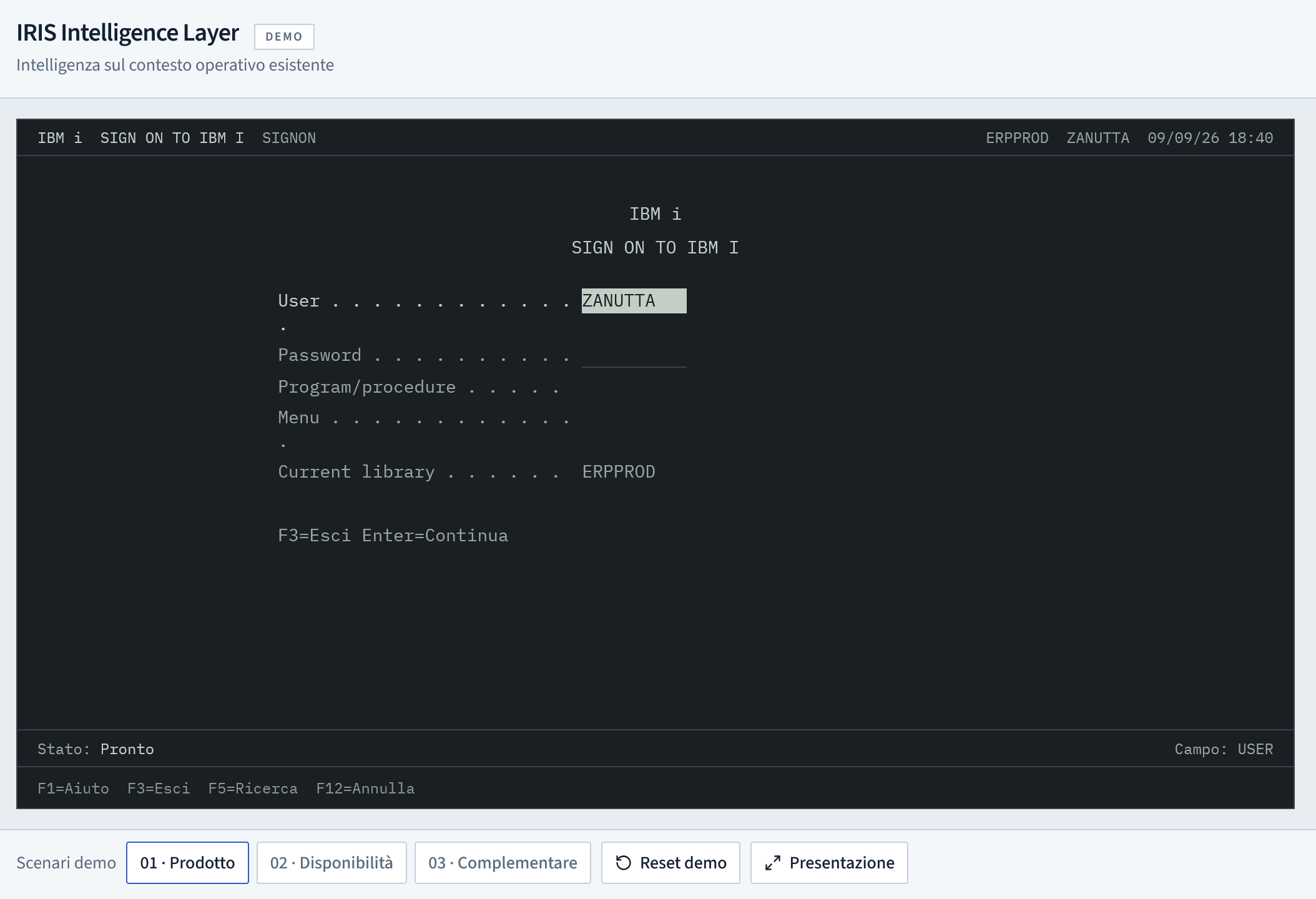
How mission-critical IBM AS/400 systems are connected to the IRIS Core AI cognitive layer, adding reasoning and traceability without replacing what already works.
Track B2B market price changes, anticipate supplier dynamics and keep your price list competitive without eroding margin.
Sep 21, 2026Read Article→
FILTER:
TIMEFRAME:
2026── From products to ecosystem(38 entries)
17.09.2026·INSIGHT·Cosen Lab
A constellation of ideas
IRIS, Cognisphere, Clabbit, GeKo, Logistics Twin, Sentinel, and related projects are brought together in a portfolio that documents an ongoing, evolving program of technology research.
17.09.2026·RESEARCH·IRIS Protocol
IRIS Protocol — Verifiable Trust
The protocol is further defined as a potential infrastructure for turning operational evidence into verifiable digital trust.
17.09.2026·RESEARCH·Sentinel
Sentinel — Autonomous Digital Defense
The project explores a new approach to cybersecurity based on continuous observation, understanding, and response.
16.09.2026·RESEARCH·Sentinel
MILESTONE
Introducing Sentinel
A new line of research begins, focused on the intelligent defense of systems, data, infrastructure, and AI environments.
15.09.2026·INSIGHT·IRIS Ecosystem
When AI becomes infrastructure
Governance, context, decision, evidence, and action begin to be treated as parts of a single infrastructure.
14.09.2026·RESEARCH·AGI Research
A laboratory for specialist AGI
An initial experimental environment is outlined for exploring specialized cognitive systems.
13.09.2026·RESEARCH·AGI Research
MILESTONE
Beyond the model (AGI Research)
AI research shifts from building a single model toward cognitive architectures composed of multiple capabilities.
12.09.2026·RESEARCH·IRIS + Cognisphere + E-terna
From Cognitive Systems to a Meta-Ecosystem
The projects begin to converge on a vision in which governance, context, memory, decision-making, assistance, and security can operate as parts of a shared infrastructure.
12.09.2026·RESEARCH·Cognisphere + IRIS
Building a cognitive architecture
The projects begin to converge on a common architectural vision.
11.09.2026·RESEARCH·E-terna + Cognisphere
Cognitive Infrastructure for Life
Cognisphere is explored as a cross-cutting cognitive infrastructure connecting memory, context, documents, sensors, and history within E-Terna environments.
11.09.2026·PRODUCT·Cognisphere
Cognisphere OS
The project is further developed as an infrastructure for memory, context, and cognitive continuity.
09.09.2026·PRODUCT·Zanutta / Logistics Twin
One network. One Digital Twin.
A pilot scenario is defined for a multi-site distribution network.
07.09.2026·PRODUCT·Zanutta / IRIS
From terminal to network
The pilot moves from supporting individual operators to understanding the logistics network as a whole.
06.09.2026·PRODUCT·E-terna
E-terna Home Care
E-Terna evolves into a connected care environment in which sensors, context, memory, and interaction maintain continuity among the individual, the home, family members, and care providers.
05.09.2026·INSIGHT·IRIS Core AI
Intelligence without replacement
A reflection on the future of legacy systems: not necessarily to be replaced, but to be made more intelligent.
03.09.2026·PRODUCT·IRIS Intelligence Layer
MILESTONE
IRIS meets the AS/400
A prototype demonstrates how intelligence can be added to a legacy system without altering how it operates.
27.08.2026·PRODUCT·IRIS Logistics Twin
The Logistics Control Tower
A new interface takes shape, bringing together network status, forecasts, and preventive actions.
25.08.2026·RESEARCH·IRIS Meta-Consortium
A Digital Infrastructure for Organizations
An architecture is outlined that can connect identities, delegations, governance, documents, compliance, evidence, workflows, agents, and AI systems within a coordinated environment.
20.08.2026·RESEARCH·IRIS Logistics Twin
Predictive logistics without black boxes
A deterministic model is tested for assessing capacity, load, movements, and potential logistics interventions.
18.08.2026·RESEARCH·IRIS Meta-Consortium
From Products to an Ecosystem
The concept takes shape of a digital organization able to coordinate administrative, regulatory, and operational services through IRIS, Discovery, Trust, Cognisphere, Clabbit, and Digital Twin.
13.08.2026·PRODUCT·IRIS Logistics Twin
From visibility to prediction
The Logistics Twin evolves from a snapshot of the network to the simulation of future scenarios.
06.08.2026·PRODUCT·E-terna
E-terna Home — The Digital Home
The research extends to the home environment through Digital Twin, IoT, building systems, and household documents and data, with the goal of building a persistent digital representation of the living environment.
06.08.2026·PRODUCT·IRIS Logistics Twin
MILESTONE
Introducing Logistics Twin
The Digital Twin extends into logistics and distribution.
23.07.2026·PRODUCT·IRIS Core AI
Intelligence for legacy systems
IRIS is applied to scenarios in which legacy systems and new AI capabilities must coexist rather than replace one another.
09.07.2026·RESEARCH·IRIS Protocol
From Digital Product Passport to Trust Layer
The research explores a possible evolution of the DPP toward a broader digital trust infrastructure.
25.06.2026·PRODUCT·IRIS Trust
Building the Trust Chain
The research explores how events, documents, parties, and processes can be linked through a continuous structure of evidence.
11.06.2026·RESEARCH·IRIS Protocol
Trust beyond the organization
The continuous evidence model is extended to relationships between organizations and across supply chains.
28.05.2026·PRODUCT·IRIS Discovery
From Company Twin to Operational Twin
The Digital Twin evolves from representing the organization to observing it over time.
14.05.2026·RESEARCH·IRIS Core AI
IRIS as Trust Infrastructure
Governance, identity, evidence, and trust begin to converge on a common infrastructure vision.
30.04.2026·PRODUCT·IRIS Discovery
IRIS Discovery meets AI Governance
Discovery is extended to the structured assessment of systems and processes that involve artificial intelligence.
16.04.2026·INSIGHT·GeKo
Decisions before action
Simulation becomes a tool for exploring scenarios before intervening on real systems.
02.04.2026·PRODUCT·GeKo
MILESTONE
Introducing GeKo
A dedicated environment is established for simulating scenarios and exploring the consequences of decisions.
19.03.2026·PRODUCT·Clabbit
MILESTONE
Clabbit — A Conversation Operating System
The project is defined as a conversational operating environment rather than a simple chat application.
05.03.2026·PRODUCT·Clabbit
Beyond the chatbot
Clabbit evolves toward a contextual interaction model in which conversation, memory, and permissions become part of the same environment.
19.02.2026·INSIGHT·Cognisphere
Information is not understanding
A reflection on the gap between the availability of information and a genuine understanding of context.
06.02.2026·PRODUCT·Cognisphere
MILESTONE
Introducing Cognisphere
A cognitive infrastructure takes shape, designed to organize context before it is used by AI.
22.01.2026·RESEARCH·Cognisphere
Context before intelligence
A new line of research begins, focused on managing context, memory, and informational relationships.
08.01.2026·RESEARCH·IRIS Core AI
The age of AI Agents
The research extends from model governance to the governance of AI systems capable of acting autonomously.
2025── The Foundations(18 entries)
12.12.2025·RESEARCH·IRIS Protocol
MILESTONE
IRIS Protocol — Continuous Evidence
The concept takes shape of a protocol dedicated to the continuous collection and verification of evidence.
26.11.2025·RESEARCH·IRIS Protocol
Beyond certification
The research introduces the idea of continuous verification, rather than a periodic snapshot of an organization.
07.11.2025·PRODUCT·IRIS Discovery
The digital certification dossier
Collected evidence is organized into a reusable digital dossier for assessment and compliance.
21.10.2025·PRODUCT·IRIS Discovery
IRIS Discovery becomes operational
The project evolves into a practical platform for discovery, assessment, and structured evidence collection.
02.10.2025·PRODUCT·IRIS Discovery
61 rules for understanding an organization
A first parametric engine is developed for the structured analysis of organizations.
15.09.2025·PRODUCT·IRIS Discovery
From questionnaire to Company X-Ray
Organizational analysis evolves toward a deeper reading of structure, risks, processes, and dependencies.
28.08.2025·PRODUCT·IRIS Discovery
Company Twin
A digital model takes shape that can represent an organization's structure, processes, data, and evidence.
05.08.2025·PRODUCT·IRIS Discovery
The company as a Digital Twin
The concept of AI infrastructure is extended to the digital representation of the organization.
17.07.2025·RESEARCH·IRIS
From static compliance to continuous compliance
The research moves toward a model in which compliance can be observed during day-to-day operations.
26.06.2025·RESEARCH·IRIS Trust
MILESTONE
Introducing IRIS Trust
The idea emerges of representing trustworthiness through available evidence and its continuity over time.
11.06.2025·INSIGHT·IRIS Core AI
When AI needs to be proven
A reflection on the relationship between automation, accountability, and the ability to reconstruct what a system has done.
18.05.2025·PRODUCT·IRIS Core AI
Identity. Policy. Evidence.
Some of the first structural elements of the IRIS architecture are defined.
29.04.2025·RESEARCH·IRIS Core AI
AI Governance Infrastructure
IRIS takes on a broader scope: not only AI, but the governance of systems, decisions, processes, and evidence.
03.04.2025·INSIGHT·IRIS Core AI
From data to evidence
Operational data begins to be treated not merely as information, but as potentially verifiable evidence.
12.03.2025·PRODUCT·IRIS Core AI
An infrastructure above existing systems
The non-invasive approach is defined: adding intelligence and governance without replacing existing infrastructure.
21.02.2025·RESEARCH·IRIS Core AI
Making AI decisions traceable
The concept takes shape of a verifiable trail of AI-assisted decisions.
04.02.2025·INSIGHT·IRIS Core AI
From answers to decisions
The research shifts from AI as a question-answering tool to AI as a component of decision-making processes.
15.01.2025·RESEARCH·IRIS Core AI
A different approach to AI infrastructure
Research begins on an infrastructure capable of connecting artificial intelligence, organizational processes, and decisions.
05 // THE EVOLUTION
Systems Convergence Trajectory
A progression from point capabilities to an interconnected digital trust and cognitive fabric.
LAYER 01 // GOVERNANCE & EVIDENCE
IRIS Core AI→
IRIS Discovery→
IRIS Trust→
IRIS Protocol
↓
LAYER 02 // COGNITIVE & DECISIONAL SYSTEMS
Cognisphere→
Clabbit→
GeKo
↓
LAYER 03 // EMBODIED TWINS & DEFENSE
Digital Twins→
AGI Research→
Sentinel
“From AI governance and evidence to cognitive systems, autonomous intelligence and digital defense.”
06 // RESEARCH HORIZON
A constellation of ideas evolving into an integrated technology ecosystem.
From early conceptual notes in January 2025 to operational platforms, multi-domain digital twins, and autonomous defense architectures in late 2026.